Why I stopped using Pipedrive (and what our team built me instead)
I was spending more time working around my CRM than with it. So I stopped renting it. My colleagues built Indigo Works, a CRM where AI does the legwork and I make the calls. Is your team still paying for tools it has outgrown?
Don't get me wrong, Pipedrive is a great tool, and I'd still recommend it to plenty of companies. It taught me a lot about how a clean pipeline should work: clear deal stages, activities tied to every deal, nothing left without a next step.
But a few months in, I noticed something. I was spending more and more time working around the tool instead of with it.
The gap
The problem wasn't Pipedrive. It was the gap. My daily work looks less and less like "log into a CRM and click through deals." I work with Claude as my assistant through an MCP layer. AI drafts my outreach, researches prospects, checks whether a company is already in our pipeline, and prepares meeting notes. The CRM is just one of the systems the AI needs to talk to, alongside my email and calendar.
With Pipedrive, that connection was fragile. The MCP server I ran locally would crash after a few dozen calls, so I got into the habit of running a health check before every write. That's fine for a weekend experiment. It's not fine when it's the backbone of my sales process.
And every day, I wanted small things the tool couldn't do. Fields that matched how Slovenian B2B sales actually works. Workflows that fit how we sell: partner tracks, public tenders, local events, EU consortium projects and staff augmentation. Things that make sense for us and nobody else.
So my colleagues built me a CRM
I am not a software developer but we are a software company. Our whole message to clients is "Stop renting software. Start owning it." At some point, it felt a little strange that I was renting my most important work tool.
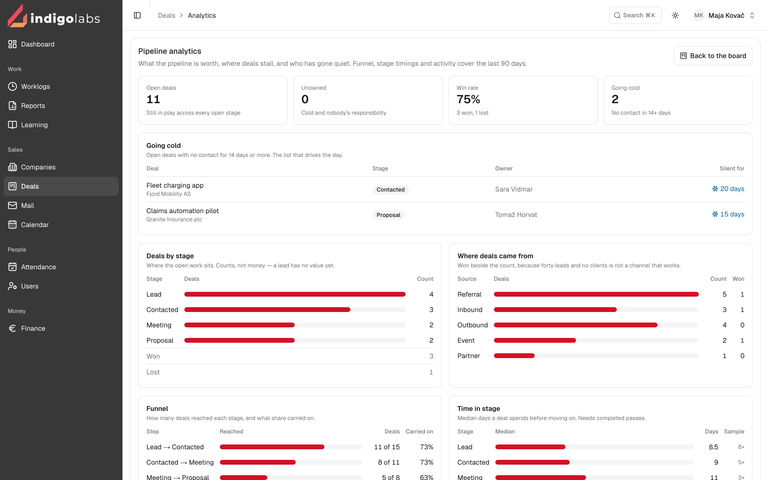
So my team built Indigo Works, a custom AI CRM designed around how I actually work. They took everything I liked about Pipedrive, the pipeline logic, the deal and contact structure, the focus on the next activity, and rebuilt it around my needs. Then they made it AI-native from day one.

Here's what that looks like in practice:
- It's connected to everything I use. Gmail and Google Calendar are built in. When a meeting gets agreed over email, it lands in our shared Indigo Labs calendar.

- AI is a first-class user, not an add-on. Claude Desktop on my computer connects to Indigo Works through a stable MCP layer. I can ask it to check for duplicates, create a company, open a deal and add contacts, all in one flow, without the crashes.
- Drafts, analysis and automation happen where the data lives. Outreach drafts, pipeline reviews and weekly status updates come straight from live CRM data, not from copy-pasted exports.
- Claude Cowork runs my reusable skills, with me always in the loop. I've built repeatable workflows in Claude Cowork that check my inbox, suggest moving deals to the next stage, and prepare a list of recommended next actions. The AI does the legwork and proposes. I review, adjust and approve. Nothing moves in the pipeline or goes out to a client without a human decision.

- We own it. If I need a new field, a new stage or a new automation, I ask the team. No feature requests into a void, no pricing tier upgrades.
What changed for me
The biggest change isn't a feature. It's that the CRM finally fits the way I work, instead of the other way around. I spend my time on conversations with clients and partners, not on data entry or babysitting integrations. Using Claude
And every week, the system gets a little better, because the team building it is close to me, just like we integrate deeply into customer's teams.
What this means for you
I'm telling this story because it's exactly what we do for our clients. Many companies run on SaaS tools they've outgrown: paying for seats and features they don't use, and working around limits they can't change. Add AI to the picture, and the gap between "off the shelf" and "built for us" gets wider every month.
That doesn't mean everyone should replace their CRM tomorrow. Sometimes buying is the right call. That's why we start with an honest Build vs Buy assessment. But if your team is working around its tools every day or the tools are legacy enough to deserve a replacement, it might be time to ask whether you should own them instead.
If you're curious what that could look like for your company, let's talk.
Matej Marn, Head of Business Development, Indigo Labs
Estimate
Have a project in mind?
Share your idea with us and we’ll provide you with a feasibility check and an estimate.